
Doesn’t the Electrical Service Panel HAVE to have a Main Disconnect Breaker?”

The simple answer to this question is, “No—Probably not.”
Because most electrical service panels are NOT installed by homeowners or “Uncle Harry,” it is actually pretty rare to find a main panel without a main disconnect. There are a couple of ways where it might “appear” to be missing—but is in fact there after all. My goal is to keep this post simple enough that most readers can understand what I am talking about.
Real estate agents and home owners need to understand the basic principles so that when the inspector calls for replacement of what appears to be a perfectly good panel, they can understand why.
The first point I will make is that ALL electrical services to the home MUST have a means of shutting off all the power.
Being able to shut off all of the power is usually achieved by a Main Disconnect Breaker in the electrical service panel—and should be labeled as such. (I am not going to talk about fuses in this post). Where it gets a little confusing is when that main disconnect breaker is in a different location from the panel in the home—like outside the home at the electric meter (as in mobile homes, townhouses, condos and other instances). In these instances the panel in the home is not the electrical service equipment but is instead called a sub-panel. This type of panel doesn’t “require” a main breaker unless it is in a detached structure. Of course it does no harm to have one and one is often installed for convenience.
The following picture is of a pretty close to correctly wired sub-panel. As a Seattle Home Inspector I love finding panels this nicely wired. This type of panel will not usually have a main disconnect—it will be located at the electrical service equipment—-typically where the meters are located.

There is another type of panel that looks, at first glance, like it might be missing a main breaker. This type of panel is configured such that it takes a maximum of 6 throws to shut all the power off.
This type of Service Panel is called a Split-Bus Panel.
The following picture is of a typical split bus panel with its dead-front cover in place. Notice it says, “SERVICE DISCONNECTS” in the center between the upper breakers?
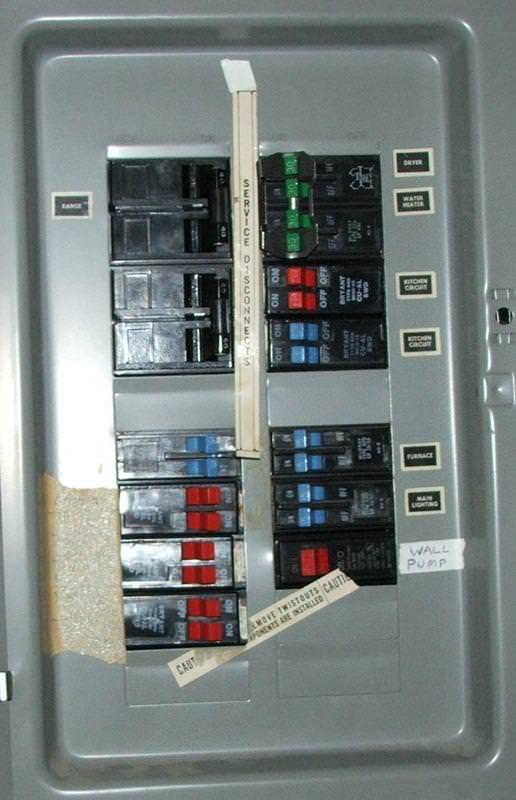
This means that when all those top breakers are turned off—all power to the breakers in the panel will be off—including the lower breakers.
The next picture is of a split bus panel with the cover off—notice how much it looks like the sub-panel picture above (well except for neatness)?

What is different about the panels can be visualized by by the following picture with descriptive overlays.

The blue dotted lines are where the power coming into the panel attach to the bus bars. Note that the top six double pole breaker spaces are outlined with blue dotted lines and are numbered 1 through 6. Note how the wires from breaker #2 travel down behind the six spaces and attach (trust me) to the bars for the bottom breakers highlighted in red. Notice also that some of the double pole breakers in the area labeled “Service Disconnects” have been changed to single pole breakers—violating the 6 throw rule. Violations of this type are common with these panels as more circuits are desired and there just isn’t room in the panel for any more.
Here is another panel with only three double pole breakers in the top six spaces but one of them has blue wires that run to the bus bars for the lower circuits.

In this case it only takes three throws to shut off all the power in the panel—still well under the 6 throw rule.
These panels were common into the early 70’s and I still find them very often. Most panel manufacturers made such panels—-and in many different versions. The code allows for this type of panel as long as all the power can be shut-off in 6 throws or less—known as the “6-Throw Rule.” Inspectors and homeowners sometimes mistake these split-bus panels for sub-panels and incorrectly call for repairs to the way they are wired—or wonder where the main breaker is. I don’t want to go into the differences between how service panels are wired differently from sub-panels, but just understand that they are wired VERY differently and it important for the home inspector to know these differences.
To recap:
In a typical split bus panel found in a residence there will be provision for “6” double pole breakers (or less)—one of which is the disconnect for all the breakers located below the 6 double pole breaker locations. Wires will run from that one breaker and be connected directly to the bus bars for the other section of breakers. (Bus bars are the energized metal bars that the circuit breakers connect to.)
These panels are often crowded and no longer have ample space to accommodate modern wiring requirements. Most of the time I find myself recommending to my buyers that they upgrade these panels. Often the service size itself is adequate for the home—the panel simply lacks the space to add new circuits. Replacing just the panel is almost always going to be cheaper than a whole new service to the home.
Charles Buell, Seattle Home Inspector
If you enjoyed this post, and would like to get notices of new posts to my blog, please subscribe via email in the little box to the right. I promise NO spamming of your email


Very helpful post. I’m curious, is it easier to add a sub panel underneath a split bus panel and rewire the house to that or just replace the old panel entirely? I am updating a house from the 40’s that appears to have had a few piecemeal updates here and there but nothing seems to have been done “right”. Lots of electrical tape, few proper junctions and willy-nilly outlets piggybacked to odd lines throughout the house.
I am a student and cannot afford to hire an electrician. Updating this old house will be my part-time job over the next few years, and I hope to make a small profit from its sell.
Well of course one could add a sub-panel but in the end you will still have the old main panel with no main disconnect. Even with a new panel for the same size service you can generally get a panel with a main breaker that has more available spaces for circuits than the current split-bus has. I am assuming all work is being done under permits, so having to pull the meter to replace the whole panel should not be an issue.
Charles,
I don’t see a main equipment grounding conductor coming in the sub panel to the lug on the grounding bar? There should be 4 conductors (2 hots,1 neutral,and 1 equipment grounding conductor) Correct?
Duncan, in this installation the metal conduit to the panel is the acting as the grounding conductor.
Charles,
In response to my to previous reply,you said the metel conduit is acting as
the grounding conductor in the subpanel. I don’t see a metal bonding bushing on the conduit to ground the subpanel enclosure? All I see is a gray fiber bushing which just screws on the threads of the conduit to protect the conductors. I still think you need a grounding conductor run back to the main panel which feeds the subpanel. If your using the metal conduit solely as a ground, what would happen if one or more of the fittings (couplings etc.)would come loose or disconnected being used as the ground path back to the service? Could cause a fire. I know for this reason,good practice tells me to run a grounding CONDUCTOR back to the source.
regards,
Duncan
Yes, and that is exactly why they do not allow it any more. The metal lock nut under the plastic bushing was considered adequate to connect the conduit to the box itself—continuity of the conduit was “usual” but difficult to “guarantee.” I have found them disconnected—but that is considered rare but due to the possibility we now want to see a ground wire inside the conduit.
I have a question can I wire a sub box to the service line without a main breaker? I do not want to upgrade to 200amp service but I do have a small box that I would like to use because my 100 amp box is full. The box I have does not have a space for a main shut off.
You will need to feed the new panel from a breaker in the old panel, and unless your new panel is in a detached building it does not need its own main in the new box. Consult with the electrical contractor as to your specific installation.
i have an old house that has no service disconnects just a meter base and a split bus pannel inside. theere is no main disconnect anywhere. the distribution pannel is inside. i want to upgtrade the dis pannel. do i have to add a pannel with disconnects or will the individual circuit breakers suffice
Carlos, I am not sure why you would want a nice new panel and not want a main disconnect? Am I reading you correctly? As far as I know, you have to have a single main disconnect in modern installations.
Hi just a note, my house is only 6 years old outside the main Panel combo meter has no main disconnect, just breakers for sub panel in the Garage, Ac heat Range and irrigation. How can i hookup a portal Generator to the main Panel without backfeeding? Do i have to install a double throw switch or install a new Main Panel with a main breaker and then a interlocking kit ?
I would have to see pictures of what you are talking about. Feel free to email me directly.
Great Blog! My father and I were both convinced that my service panel was missing the main breaker, but I see that I have a Split Buss panel thanks to your blog. I purchased a home in MI without an inspection or seeing it in person. I inherited a box that is overlystuffed and even had wires connected directly into the front with the cover off! In the state of MI they require an electrical safety inspection on any home that has the electricity off for more than a year (mine has been off for 3 now). So I am preparing myself to clean up some of the obvious no, no’s and have the inspection. Hopefully, my nothern Mi inspector will be as knowledgeable and helpful as you seem to be. Keep up the good work! Wish you were in MI!
Dennis, glad to be of help—good luck with your MI inspector—I have heard about these inspections in MI.
Great post! I was convinced my daughter’s “new” (1950’s) old house was missing the main breaker but now understand much better what’s going on with the split bus panel. One question though. What overcurrent device protects the incoming wiring from the meter to the panel? Our 1950’s house has 120/240 volt #4 AWG copper TW which I think is good for only 60 Amps. When I add up the breakers on the first half of the split it comes out to more than 60. I have not found any main breaker upstream of the panel but am wondering if there are fuses or something hidden in the sealed meter enclosure. Any comments would be greatly appreciated. Thanks!
Louis, regardless of whether there is a main breaker in the panel or a split-bus means of disconnecting the power there is no protection of the wire between the meter and the panel and why it has to be in conduit and a very short distance between the two. Also adding up the amperage of breakers is not really indicative of anything except as indicated by the data plate. #4AWG copper is good for 100amps typically. Have the panel evaluated by an electrician if you have concerns about it.
Dear Louis,
I’m rewiring a house to make it more EMF friendly
ie no EMF’s.
It was suggested to use split bus to separate the loads. Emf high loads and resistive loads.
A few details please!
I’m suffering from emf sensitivity.
Ann, I know of no scientific evidence to support that EMF’s are a problem related to residential wiring. A Split Bus panel is a type of panel and would likely not make a difference in any electrical conditions related to EMF’s that I am aware of. “Anecdotal” information can sometimes seem convincing but generally just confuses the issue.
I live in a townhouse and the circuit breaker panel appears having no main breaker, where a square hole above the two columns of circuit breakers is labelled “Main” but it is really an empty hole covered by two plastic pieces. I guess the circuit breaker panel in my unit is of the type you described in this article, a sub-panel.
The circuit breaker dedicated to the kitchen’s under-sink waste disposal seems out of service, no power is available on this line when this breaker is flicked on, and it won’t trip either. So I’d like to replace this circuit breaker with a new one. However, all I read on how to replace a circuit breaker recommend to “turn off the power at the main breaker”
You mentioned in this article about sub-panel, ” This type of panel doesn’t “require” a main breaker”, should I interpret this as I can replace the faulty circuit breaker without bothering to find out where the main breaker outside my unit is? Or, I have to turn off the main breaker outside my unit, which I assume is inside a box at the end of the building and locked up, so I really have no direct access to unless through the power company.
In the whole last paragraph I am only guessing the possibilities. I hope you’d give me some advice on what I could do in this situation. Thank you for your help in advance.
Tom, based on the questions you ask I must suggest that you contact an electrician to make these repairs for you.
I have a split bus panel from pushmatic. Home was built here in Michigan in 1965. The main lines from the meter go into the top of the panel in side my one family home. The first two breakers are 30amp and then a 60 amp panel starts for home lighting. I’d like a 100 main put inline but, the electricians here say it’s just better to upgrade the panel. There is nothing wrong with this panel other then not having a main 100 amp breaker. I can’t see spending $1500. to $2500. on a new panel install. Any ideas on what I should do??
Thanks Joe
Joel, besides the lack of a main breaker there are other reasons why you should be looking to upgrade the panel. If there is nothing wrong with the panel, as you say, other than missing a main breaker why not just leave it alone? There is nothing inherently wrong with a split-bus panel. The problems arise when you need more spaces for modern circuit requirements when remodeling. If the six throw rule cannot be maintained it is time to upgrade. There is often insufficient space in these older panels and often breakers have been double lugged. I think you are probably getting good advise to upgrade the panel. If you don’t have to upgrade the entire service you should be able to get just the panel changed out for under $1500.00—it certainly would not cost more than that in my market. It will cost you something to have a main breaker installed—just put that money toward a whole panel is my advice.
Thanks for that fast reply. I don’t need to add a breaker to the panel. To me, having a main breaker coming into the panel seemed smart. Maybe in the years to come i’ll think about a upgrade. Thanks again for your comment on this.
Joe
Hi Charles,
This article is the closest thing I could find that addresses our sub-panel problem.
We just bought a 1941 house that seems to have had the electrical panel updated by the seller (or maybe his Uncle Harry!). There is no main shut-off, only a sub-panel installed with 4 circuits for the whole house. We’re looking to have a 200-amp main panel installed professionally and run some new circuits to key appliance outlets as we can afford to do so.
We got a local recommendation from a trusted source here in L.A. and the electrician just gave us a quote. His plan is to leave the sub-panel as-is (cloth wiring and all) and only run any new circuits we’ve requested from the new main panel. I understand that this, in theory, should be fine but we had an earlier quote from our real estate agent’s contractor which included rewiring all of the circuits to the new panel (and for a good deal less).
Is this just a matter of preference or is there a right way to do it?
Thanks!
Kevin
Kevin, it can be done either way most likely if I read you correctly. If you would like to email me privately so that you could show me some pictures I might be able to advise you more appropriately.
Charles: I was supposed to get a new service panel installed today,but my electrician found that there’s a sewer drain line directly under the box. The old box is 13″ x 24″,& he says they’re no longer made.The panel is a split buss type. Any suggestions? There just isn’t any room for abigger one.We’re not looking to add anymore circuits-just a problem with the buss.
Roger, I am not sure I fully understand what you want to know. I don’t know why the electrician can’t install a new panel in place of the split-bus panel. Modern panels that size will typically accommodate a main disconnect and still have room for all the circuits. Feel free to call me if you want.
I realize this is an older post but I hope you can help me figure something out.
We recently had an electrician (a very young one) out to do some other work and after looking at our system he recommended upgrading our system to 200 amps to the tune of $6000. Doesn’t make sense as we haven’t had symptoms of a lack of ampage – no frequently tripped breakers, flickering lights or the like. Reported that we currently have 150 amp service. He also expressed concern that we had no main shutoff.
I looked back at our home inspection report to see if this issue was mentioned. The inspection report states that we do have 200 amp service. So I’m looking at the service panel trying to figure out what is going on and I’m confused.
We have a large panel with 42 receptacles – several of which are not used. At the top left of the panel (which I understand to be where the main shutoff should be) is a double breaker with 100 printed on it, however it is labeled “Heat”. There are 4 breakers below it in place 5,7,9,11- 2 single switches and one double switch with 60 printed on it – all labeled “Sub-Main”. On the right side there are also 3 other double switches with 50-range, 30 – water heater and 30 – dryer. The breakers on the bottom half are all single and mostly printed with 20 and 30.
So could this possibly be one of these split bus systems and that’s why there is no main shutoff? And do I have 100, 150 or 200 amp service?
Home built in 1978, all electric, a little over 1600 sqf.
Thanks for any enlightenment you can give.
Jessica, this sounds very much consistent with a split bus panel. There are many factors that would come into play to determine whether it should be replaced or not. The needs of the home. The manufacturer. Is there space for more circuits, etc. If you send me a picture privately I will try to be of further assistance. On the panel legend it should tell you the panel rating (size). If that is missing it may also be on a legend inside the panel but I would not recommend you remove the dead front.
I have a dual split bus or whatever panel… I am going to have a throw switch installed with a lock assembly between the meter and the panel so I can kill power in one throw. This will also prevent back feed of my generator. Any thoughts on this?
Sounds like it can be done—just make sure it is done by a licensed electrical contractor.
Charles,
According to your description, I seem to have a split bus panel in my 1959-built home. Since we have many trees in the area, I am sorry to say that loss of power is becoming more common and I would like to be able to plug in a portable 7KW run-rated generator to power the in-house well jet pump, gas fired hot water furnace, and 2 refrigerator/freezers. Can an interlock be installed on a split bus panel to guaranty that only one source of power is connected?
If a panel interlock switch can not be installed, I can use extensions from the portable generator to power the refrigerators and furnace (a 110 plug is built into the control unit and the emergency switch can be thrown to off), however how can I provide emergency power to my 220V jet pump? There is a small power box installed next to the pump that contains (2) 15A glass fuses used to cut power to the pump.
I would appreciate your thoughts and suggestions.
Ray
Ray, I just inspected a 1959 house with a split bus panel 🙂 I am pretty certain that you cannot put an interlock type generator interface on it. Consult with a licensed electrician however. Given the age of the panel you might want to consider upgrading than the work it would take to making the old one work.
Thank you for your quick reply. I appreciate that an upgrade would be best but not an option at this time. If an interlock can not be installed on the split-bus panel, how can I apply generator power to my in-home 220v jet pump servicing my water well? As mentioned above, along with the circuit breaker on my split-bus panel, there is a small power box installed next to the pump that contains (2) 15A glass fuses. Would it be a good idea to install a 220v twist receptacle between the small power box and pump to apply emergency power? Although I would be eliminating the short cut-off of the local fuse box, I am depending on the generator’s circuit breaker for any short encountered on any of the other connections.
Again, thank you for your article and response. It has been very helpful.
Ray, I am afraid you have gone beyond my pay grade 🙂 These interfaces can be incredibly dangerous to workers down line of the service, so making sure these installations are done properly is critical. Consult with an electrician at this point. I will say though, that making an interface work (if it can be done) with this old system may be more expensive than simply upgrading the panel.
From your description it seems I have a split bus electrical panel. One of my double pole breakers has been tripping frequently ( to my range) and makes a buzzing sound from time to time. I’m thinking it may need to be replaced. As there is no main shut off, would I need the power company to turn off my power first? Does it sound like a problem that replacing the breaker will resolve?
Shari, too many possibilities to diagnose from the information you give. Time to have an electrician check it out for you. The power company will not likely be necessary to change the breaker—just an electrician.
Just looked at a home that my niece was thinking of buying to render an opinion on its condition. (I’ve been a residential carpenter for 30 years.) I couldn’t figure out why there was no main shut off breaker in the circuit breaker box. The box was rated at 125 amps but only had a 60 and 30 amp double pole breakers in the top 2 spots. It must have been a split bus panel as you so clearly explained on this webpage. Thanks for the very informative description of this type of panel that I never new existed.
I have a split- bus panel which is located under meter and sub-panel is in the house. One of the 100 amp breakers is tripping and I need to replace it. There is no main labeled, so if I cut all breakers off in panel under meter, will power to house and this box be off.
I can’t tell you anything based on the information given. Pictures might help, but an electrician might be your safest bet.
Charles
This article is excellent, thank you. My client just had a home inspection done on a 1972 home. The inspector noted that there was no main breaker and that code required it since 1937. This made sense to me at the time. I started reading on, came across yoru article, and realized this must be a split bus panel. SO…if I am understanding this peroperly, this set-up is fine unless of course the new homeowner wants to add more circuits.
To cut power off entirely- all the upper breakers must be flipped, correct?
I shared the link to this article with the inspector and asked him to read it as well. I don’t want to be askign the seller for work to be done on something that is not necessarily defective.
Thanks, Tom
Hi Tom, the “code” certainly has allowed split bus panels for a long time—in fact the 6 throw rule still applies although I doubt any manufacturers are still making a split bus panel. They pretty much went out of favor sometime in the 80’s—at least in my area. As long as you can shut off all the power in six throws or less you should be good to go in that respect but there may be other issues typical of any older installation. Lots of these panels are fine—some are very crowded and need upgrading.
I have what appears to be a split bus 100 Amp panel mounted directly below the meter. This would have been added to the 1950 house when “most” of the wiring was updated. Immediate plans are to add a 16 kW generator with 200 Amp auto transfer switch panel. Long term (2 to 3 year) plans are to add on to the house including removing the entire rear wall of the house where the panel is located. That would result in a relocated, entirely new 200 Amp service and total rewire of entire gutted house.
Advice from electricians vary. One says I must upgrade to a 200 Amp panel now before adding the generator, even though the new panel will have to be moved in the future ($3000 for new panel and wiring generator.) Other advice is to connect wires from meter and wires from generator appropriately to the 200 Amp auto switch panel which will adequately and safely control power fed to existing 100 Amp split bus panel. Optional 100 Amp breaker box could be added between auto switch panel if local inspectors don’t like 200 Amp feeding 100 Amp panel. Third advice was to add a new 200 Amp panel nearby to be fed from auto switch panel (meter or generator). This 200 Amp panel would then have only one 100 Amp breaker that feed the existing 100 Amp panel which effectively becomes a sub panel (less wiring and easier to move panel during remodel).
Which makes more sense?
Even though the trend has been to upgrade to higher Amperage panels in recent years, I am confident that my 1800 sq ft remodeled home will draw less Amps/Wattage than in its current 1200 Sq Ft state due to deep energy upgrades (tight/insulated envelope, more efficient lighting and appliances) and a smaller furnace/AC combo (2 ton 16 SEER/ 96% eff 36,000 BTU furnace vs current leaky duct 3 ton 12 SEER / 60,000 BTU single stage furnace). So I really wonder if we are looking at electric service upgrades in the wrong way anyway?
I assume you are putting in the 200 amp generator disconnect in anticipation of the new 200 amp service? Why not do that but simply change out the disconnect breaker to a 100 amp breaker so that it fits with the existing service and then change the breaker back to 200 amps when and if the service gets upgraded? This may or may not be an option—discuss with the electrician. Also I would consider an “in-panel” type of generator disconnect as opposed to an isolated type. This could all be done by simply replacing the existing split bus panel with a new 100 amp panel and a $50.00 transfer kit.
You are correct about the anticipation of the 200 Amp service. While I have no plans to do so, 12 of the nearest 15 homes have been recently torn down or doubled/tripled/quadrupled and McMansionized. For the low cost to upgrade transfer switch now, I figure it will make it a positive for resale in the future, or at least not a negative.
I like the idea of changing the disconnect breaker from 200Amp to 100 Amp. I will investigate the brand I am looking at to see if that is possible.
I could live with the manual disconnect inside the panel, but MSOWMABO (my significant other who must always be obeyed) insists on it being automatic, and she is willing to foot the extra bill. I have, however, shown at least one neighbor how a simple transfer kit would allow them to use their portable generator without extension cords. It’s purely coincidental that that neighbor is the most likely to annoy me on any given day and even more likely to crash at out house during a power outage.
Thanks for your advice!
BTW, excellent explanation of split-bus panels!!!
I am in a large apt building circa 1960 construction. I was removing a light fixture to replace it and the black power line shorted out against the jbox as I moved it. (I neglected to at least turn off the light at its switch) Now, in my new split bus bar panel, half the breakers are not working. I have two 120v supply lines and a 200A rated panel.
I moved them all to one side but am very worried this is a load imbalance (although it’s mostly for modest lights and no AC this time of year.)
Is the main breaker bad? Could there be a fuse box in the basement to check?
In short, excuse the pun, I know I need an electrician in but any advice would be of interest.
Thanks in advance,
Scott
Scott, I wish I could help but you have not given me the kind of information that I would hazard a guess about. Like you already know, call a sparky and get it sorted out. I can tell you, that it probably won’t be too difficult.
Hi Charles great article. I just bought a home and the home inspection states that i have a 200amp main disconnect and a 100amp entry. Does this mean I have a 200amp underground service from the power company to the house? Then a 100 amp panel entering the home? I’m unclear why there would be a 200amp main disconnect?
Brent, can you send me some pictures?
I take the possession of the home in 2 weeks. I can send them at that point. Wow really appreciate the quick response. That’s GREAT.
Did the inspector put any pictures of the panel interior in the report?
No just and outside breaker shot. No pictures of the main disconnect. It won’t let me paste the pics i have from the report here.
Brent, email me privately when you have some pics.
I really liked the article but now I have a bunch of questions, to post here now. One that I can post is that I have a home built in 1999 that has the 150 amp main breaker located by the power meter.
The panel in the garage does not have enough room to add the needed breakers for me to add power outlets in the gearage where I am making it my work shop. I will need at least two 220v @ 20amp and six 110v @ 20amp breakers.
I forgot to mention it is a Cutler-Hammer panel. Would I upgrade the panel or run a subpanel off of it to accommodate the workshop breakers/outlets?
Thanks,
Dean
I have ran out of breakers. This house was built in 1965 and has the split bus. I notice some of the circuits are just for lights and some have several outlets for example, microwave, toaster, items like this. Can I, using a pigtail in the panel change a couple of the outlets to a different breaker? After testing the circuits I have found what wires run what things.
Sorry, Joe, I don’t have enough information to help you. I recommend you call an electrician that can actually look at your situation.
I have to tie a solar photovoltaic (PV) system (1.5 kWac) into the residential electrical service panel of a customer. The service panel is a “Pushmatic Electric Center” with two vacant slots. I plan to insert a 2-pole 20 A Pushmatic circuit breaker into one of the slots and tie the PV system (240 V, single phase) to it so that PV electricity can flow to residential loads and/or back to utility for credit (net metering). After reading your explanation of split bus service panels, I believe that is what I have here. My question is: “How do I insert the Pushmatic breaker and wire to it safely, as the two vertical buses are always energized?” Do I need to pull the meter to break the connection between utility lines and service panel, or is there a more convenient way to do this? Thanks very much for considering my question.
I am afraid you are going to have to consult with a licensed electrical contractor that is experienced in the installation of PV systems. I strongly urge upgrading the ancient pushmatic in the context of any new installation.
Thanks for the excellent explanation. I’ve been in the RE and home remodeling business for over 50 years and have seen these and other odd layouts of electrical – many of which are perfectly legal and allowed as long as no changes are made to them. Even now however, I see odd wiring schemes in older buildings that can still mystify me and have recently run into another.
Discovered a new “mystery” panel lately and cannot figure out what the heck is going on in this building. I hope you can comment/help/offer some guidance. The panels are old “stab-lock type panels and are at least 50 if not 60 years old. The building was originally built as in city apartments c. 1959, and later converted to condos sometime in the late 60’s/early 70’s. There are two floors in each building. With 12 units per floor. The AC is central water-cooled and there are individual air handlers that utilize the cold or hot water from the chillers. The Water-based air handlers have 220 v motors in all of them. Also, each apartment has an electric stove – full sized. Minimum of 40 – 50 amps required for each of them. The breakers for the lights, outlets are in two centralized panels in the hallway on each floor (2 per floor) but these panels have NO 220v breakers in them what-so-ever. Nor is there any mention made of stove or air handler/AC shut offs!
An older-than-I-am electrical engineer friend proffered the thought that perhaps there were central 220v panels running the stove and AC in each apartment. However we cannot find any such animal! There is a “mystery panel” outside of the building that seems to have six or eight 100 amp breakers in it. Could this be set up to power the AC Blower motors and/or stoves across multiple apartments? It isn’t labeled. And I can find no place else that has a large number of 220v breakers. However even with 8 of them @ 100 amps each – could those be used to meet the power draw of 3 stoves @ 40-50 amps each? And then you’ve got no way to power off the individual stoves (or air handlers if that’s what it’s connected to.)
I’m lost. Any ideas of what may have been legal back then in a multi-unit building. BTW: these were built as modern, but high end “luxury” apartments in Phoenix and are very near the Phoenix Country Club and the Art Museums, Opera, etc. Even in their days as apartments they were ‘pricey’ and marketed to upscale renters. As condos they’re very much in demand because of 50 year old landscaping and the spaciousness of the layouts. However this strange electrical set-up is discouraging me from buying a couple of these units. I sense a potential for a big rewiring job or a fire hazard or both. And rewiring these to current codes would probably run in excess of $5000 per unit for the 1br/1ba and more for the larger units. Possibly much more!
Any thoughts or ideas about what I am seeing and how this thing may have been wired to accommodate 12 stoves and 12 air handlers per floor and yet only have 8 100 amp 220 breakers visible anywhere in the building that we can find – so far???
MI, if you could send me some pictures privately I might be of some assistance. That said it is not practical or advisable to attempt to maintain these Stab-loc panels. They should be replaced in my opinion and at that time any wiring deficiencies would/could be resolved—likely. It is unlikely that the several 100 amp disconnects have anything to do with the ranges etc and are more likely the main disconnects for the panels on each floor, or in units, or HVAC units or something else. If you have pictures of the interiors of the panels or even the face of the breakers with the dead-front still on, something may jump out at me.
Hi,
I am installing a 100 amp subpanel in a detached garage. Obviously the neutral and ground need to be separated, but what about the main breaker (I had to buy a 100 amp main panel.)
Can I leave the main 100 amp breaker in the subpanel, or do I need to remove it? If so, how?
Jake, anything I say should not be a substitute for proper evaluation by a licensed electrical contractor, but any sub-panel in a detached building is, among other things, required to have a main disconnect.
Just wanted to say thanks for the excellent description/explanation of split bus panels. I have one in my house, and I couldn’t figure out why I didn’t have a main disconnect.
Charles
Great Blog and very helpful.
I do have a few questions regarding my situation. I have a split bus service panel. In the top 6 there are only have 4 double breakers, one which shuts off the lower panel. One is a 50 amp and feeds my range. I am changing over to gas and only need a single pole 20 amp breaker. I want to change it to a single pole breaker so I can use the same wires for my gas stove. In the breaker box I will take one wire to the neutral bar and the other to the single pole breaker. On the range side I will replace the 240 volt receptacle with a 20 amp receptacle using 12 gauge wire to pigtail off the existing larger gauge wire to install the new receptacle. Do you see any concerns with this and if I shutoff the top 4 breakers is it safe to work in breaker box to change out breaker? Thank you for your feedback
Larry, I was just about to reply to your comment on the blog post when I got a long winded phone call. Obviously I cannot tell you to just go ahead and make repairs yourself for liability reasons. I can say it is common to see single pole breakers installed in the top section of split bus panels typically reserved for 240 volt breakers. You would have to look at the panel data plate to see if the panel is rated for such installation. The key is that there can never be more breakers than would result in 6 throws. As to using the old wire to the range, that might be possible if it is three wire feed where the former ground can be utilized as the ground and one of the hots can be re-identified as a neutral. It does not matter if the wire you are attaching to it is a smaller size as long as the breaker is appropriately sized. With no main breaker a split bus panel is always going to be more dangerous to work on than a regular panel with a single disconnect and why you should have a licensed electrician do the work for you.
I do not know what code cycle you are under but current regulations would require that receptacle for the range to now be AFCI protected and that old split bus panel might not accept them.
The picture in split-buss2 shows a sub panel that I believe is wired incorrectly. Sub panels are supposed to be supplied with power from the main panel by using an SER cable that has 4 separate conductors. This permits for 2 hot , 1 neutral & 1 ground conductor. The reason for this is that in the sub panel the ground & neutral conductors are to be isolated from one another. From what I can make out in the photograph, there are only 3 leads coming from the main panel to the sub panel & the neutral buss and the ground buss are connected to each other. I believe this is a code violation. I am writing this so that no one makes the mistake of using this picture to install & wire a sub panel.
Dave, you are sort of correct. It was only relatively recently (2008 NEC code cycle) that a 4th wire became required between panelboards. For a long time the metal conduit between panels was allowed to act as the ground path (fourth wire).
Hello Charles,
My question has to do with copper clips(shoes) placed on the bus blades in Position 1 of a Seimens 250A split-bus entrance panel. These clips appear crimped on to the bus blade preventing insertion of a breaker. Generator transfer is accomplished by throwing two breakers positioned at the “split. The main breaker is a 1/4 mile down the road which, of course, has to be thrown to off first before the split bus breakers are thrown for generator transfer. Can these clips be removed to utilize the breaker position?
Hello, thank you about explanation about splitbus panels. We also got one like that and thinking about upgrade. Talking to friend he suggested to check if this is possible to just leave current panel and place and insert the main breaker in front of the current splitbus panel?
this will basically make current panel a sub panel and will also introduce single main breaker and expansion which will come with it where only few ports will be used to feed the subpanel.
Few notes: there is a space and current main feed wire can be pulled back from split bus to new panel. and then new wire run to the spilt bus. Current service is 200A.
Any feedback will be appreciated
Thank you
I would encourage looking at the big picture. A Main Breaker separate from the existing panel that could refeed the existing panel will still be expensive and you would still have the antiquated split bus panel that might not accept some of the breakers that might be required in the context of other rewiring/remodeling plans. Just bite the bullet and go for a whole new 200 amp panel with lots of room.
Damsel In Distress Here….
Help Charles, hubs never taught us how to throw the whole house.
I now know we have one of these……..bus panels.
Our AC switch needs replacing and no cash to call an Electrician. Our HVAC person retired and one other left this world.
We can get a new switch and we can install it, we are handy, but the AC switch will not move, so it is the only one left, we call kill all other power in the whole house.
We do have an external AC switch so the HVAC guy did not have to run up and down the steps to work on the outside unit.
We are so far in the hole and can not under any circumstance hire this done..
So doubt if you can help but put this out for all to learn.
Well built 1963 house, never any breaker problems as we are more off grid folks.
But it is bloody hot and I need some AC.
Most of the time we don’t use it, and our heat is set at 60/64 in the cold winter.
No money for a new box.
Thanks loved reading all comments. Have some pictures and have spoken to a commercial company where we can order these out of date switches.. company no longer in business…
Calle
Hi Calle, I love nothing better than assisting damsels in distress, however in this case, I can best assist you by advising you to have this work professionally done. If you have a breaker that needs replacement for a panel manufacturer that is no longer in existence, there is every likelihood that the entire panel should be upgraded. There is no way I can provide the kind of information necessary to work on your panel safely. Working on electrical equipment is not as simple as just changing a breaker. There is other stuff you have to know about how panels are wired and what can be energized at any given time in order to replace a breaker safety. Please figure out a way to get this work done professionally.
Charles, Thank you for this post. I believe I have a sub-panel meeting the 6 throw rule.
But I do have a question about installing a dryer in a new location:
The top left breaker feeds the dryer. I’ll need to run new wire there and was assuming that I’d need to shut down the panel. But maybe simply turning of that breaker would be sufficient? Any suggestions?
Thanks for your time.
Here is a pic of my panel:
https://imgur.com/uMxHchq
Not ignoring you permanently Brian—just real busy. Sorry. Given your panel I think you need to consider adding a sub-panel to a breaker in this panel or better yet replace the old split bus with a new modern panel with a single disconnect and plenty of room for your future and current needs.
Thanks Charles, and sorry for my impatience. I was trying to be playful but maybe should be more cautious online.
cheers, and thanks for the advice.
I Guess on second thought, I’m really only asking how can I shut down my panel.
I just want to pull the wires out of one circuit breaker–the breaker itself is fine. Just need a new wire that goes to a new place in the house.
I thought there should be way to kill the power to the panel itself, but maybe that’s unnecessary.
Cheers.
Just turning the breaker off on a split-bus is as good as it gets—and part of why it is a good idea to upgrade to a panel with a single main breaker—then everything house side of the main is de-energized. With a split bus like yours—you could take out all six of the top breakers and the bus bars would still be energized. Does this answer your question?
Thanks Charles. Dryer moved and rewired.
All done by qualified parties and permits I trust 🙂
Charles, thanks for this very thorough write up. From this, I learned that I too have a split bus panel. I need to replace one of the 2-pole breaker on the top. Question is, given the fact that there is no main disconnect on the panel, does that mean that it’s unsafe to do this work without having the energy company shut down the main power line? Thanks in advance for your help.
Safety is relative to who is doing the work. These breakers in these panels should only be replaced by qualified parties—-ie a licensed electrical contractor. The meter would typically not need to be pulled to make this change.
Hello
I’m nit sure if my issue will make any sense but here goes. I have a 20A double breaker that kept tripping. I removed the white wire that went to it popped it back on and it was feeding power to all breakers below it. Problem is all subsequent breakers were flipped off. Any ideas?
Hi Craig, please attach a picture and I “might” have something to suggest about it.
So I’m currently in process of buying a home that has a split bus panel as your described, and I want to hard wire a generator for when the power goes out. What type of options do I have since I don’t have a main shut off to isolate myself from grid power?
You can basically upgrade the panel. If it is a split-bus it is warranted regardless the transfer switch.
Charles,
Just wanted to let you know that this is the most helpful thing I found on the internet this week. The lack of a single main breaker had me scratching my head about some electrical work I was planning.
Hello, I’m not sure this site is still active, but fingers crossed. I’m in the process of buying a home. Our inspector’s biggest concern was for the Bulldog split bus system that was installed with the house in 1961. It’s a 100amp with no master, but is technically okay since it can be shut off in six motions.
Howerver, one of the breakers does not read on/off correctly and the air con is attached to a 30. I don’t know much at all about this, only what I’ve been digging for over the past 2 days. We requested that the seller upgrade the panel as it is tapped out…no more space and has two safety hazards already.
We don’t really NEED more amps, but we are concerned with the safety of the old panel. There are varied opinions about these panels, from great to junk. Even the people who love them feel they are at the end of their lives…and most of these posts are from 10 years ago. The seller feels that it isn’t necessary to fix the issue as it works fine as is. I’m looking for solid advice about its safety given there are already issues with it. Sure it might work up until it doesn’t and catches on fire or shocks one of us. Any kind of official report would be welcome too. We have a short time frame for decision making and would appreciate any help you can offer.
Thank you,
Katie, MI
Katie, I will give a stab at answering you but it will be my opinion based on my experience. Anything installed in 1961 should be considered at the end of its expected life—regardless of MFG. The Bulldogs were awesome in their day but are outdated by today’s standards more so than some other MFG’s from the same time frame. The panels generally had little working space. I do not know what electrical code cycle you are under but they represent a problem for installation of AFCI and GFCI breakers. The issue with the AC is likely a non-issue depending on what the data plate of the unit says. For a house your size, it would be unusual for a 30 amp breaker to be wrong but again, I don’t have enough information. I recommend replacement of the panel and I would hope that the cost of an electrical service upgrade would not be a deal breaker. At 1961, you likely have un-grounded type non-metallic sheathed cable and that will cost you far more than the electrical service to upgrade. As to whether you can get the seller to do the upgrade will depend on whether it constitutes a deal breaker for them. It should not be a deal breaker for either IMHO—but it sometimes is. If you provide information on the AC data plate I can better inform you as to the 30 amp breaker. I would need to know the wire size, the minimum ampacity and the Max breaker size per the data plate.
Unfortunately, I don’t know anything about the plate and don’t have access to the house at this point to look. Is there a way for me to privately send you the inspector’s report? There are a few pics attatched, though they are small. I don’t know if that would help or not. Thank you so much for your response!
Hello Charles from the wet state of Florida! My question is about main disconnects and sub panels. I just bought a house built in the 50’s with a 90’s updated breaker panel (no split bus) and an outside 200amp disconnect breaker (code requirement) by the meter. The 20 space breaker panel inside DOES NOT have a main breaker in it and about 10 breakers installed. The service coming from the street is 200amp as per the utility company
I would like to add a 100amp sub panel in the storage area that is part of my attached carport to use for tools, my hot water heater that is located there, washer dryer, etc.
From what I understand, my inside breaker panel is considered a sub panel because the disconnect is in a separate panel. So technically by adding a second sub panel off the interior panel I am daisy chaining sub panels. Will I need a main breaker or disconnect in the sub panel I want to install?
Thank you!
omg! I thought uploading a photo was for my avatar pic!!!!! lol sorry *embarrassed
Hey, it is only fair—you know what I look like 🙂
Should be no problem adding a sub-panel to the sub-panel. You will need to come of a proper breaker from the first sub-panel with proper 4 wire feed to the new sub-panel. As long as they are all in the same building there is no requirement generally for a main disconnect. Consult your electrician however.
I will consult and thank you!
I’ve called 2 companies so far and both are trying to sell me on a total house rewire because “if we touch one part of your system we are responsible for anything that happens from the rest of it” which I don’t believe.
One more thing, will I also have to run ground through a ground rod or metal water pipe at the new panel? I’ve watched a couple youtube videos and that seems to be a thing with sub panels too.
If the panel is in the same building, no additional grounding is required or a good idea typically.
Charles,
Thank you in advance for your reply. I’m attempting to provide power to my attached garage for some woodworking tools, and LED lighting. I’m getting conflicting information from two separate sources regarding what is required.
The house, which we purchased in 2016, was built in 1951. In 2015, the former owner had a new 100 amp panel installed. I do not know if it is a split bus unit. Truth is, I have no practical electrical wiring knowledge, and am leaning heavily on assistance from experienced friends – one is not an electrician, per se, but has extensive experience wiring his commercial woodworking shop(s), as well as rewiring a 1904 3-story house; the other is an actual electrician, but who does commercial work exclusively.
Originally, I intended, upon the advice of the person who did our inspection when we bought the house, to upgrade the main service panel to 200 amp, and put the nearly new 100 amp panel in the garage, which has only a single 2-outlet, 15 amp box, as a sub-panel. Again, on the advice of a friend, and given I will not have so great a power draw with my tools and lighting as to need the full upgrade, I have decided to put a small, 12-space, 125A Main Lug sub-panel in the garage/shop, run 6/3 cable to the main service panel, with a 60A breaker for potential overload.
After installing the sub-panel (no hard wiring has yet occurred), I have now been advised by my other collaborator that because the sub-panel has more than 6 spaces, it has to have a shut-off, a Main Breaker. There will be four 110V circuits, and two 220V circuits. This is a hobbyist workshop, not a full-blown professional cabinet-maker business.
The question is, do I need to pull this main lug panel and replace it with a breaker panel? I’m certain there are specifics I’m omitting as I do not know what is germane for your consideration. Please advise.
I thank you again for your reply
The advise that says you need a shut-off at the sub-panel is correct. That shut-off can be six breakers or one breaker—but if you have room for more, I would advise a main breaker in the sub-panel. You can still do that in this panel without changing the panel—that main breaker just needs to be permanently attached in the box and there are brackets to do that depending on the manufacturer. I am assuming you have pulled a 6/3 cable with a ground wire to the building so that grounds and neutrals can be properly isolated. I strongly recommend this work be done under permit and by qualified parties.
Thanks, Charles. I do indeed have a permit, and that for the original 200A upgrade and shop wiring.
Attached is an image of the sub-panel presently in place; breakers installed, but no wiring. Will this “can” accept the aforementioned breaker, and, if so, what amperage rating I should incorporate? What distinguishes a permanently installed breaker?
Yes, the 6/3 cable includes ground, and has been run across the basement from the main service panel to the attached garage/shop…again, no hard-wiring has yet been done.
I misunderstood your previous comment. I thought this sub-panel was going to be in a “detached” building. If the building is attached–the breaker for the panel located in the service equipment panel should meet requirements.
My apology for not being more clear. Definitely attached, but there is a substantial run (90 feet) traversing basement from main service to sub-panel.
Thank you again for your assistance, as well as your patience. It is greatly appreciated.
A main breaker would only be for convenience—otherwise not likely required—at least around here.
We’re not so far away…Mount Vernon (Skagit County).
Ah yes, well should be the same then.
Hi Charles,
Great webpage!
I need some help with installing a portable generator into my home wiring.
I have a subpanel in the garage and a main disconnect panel with meter on the side of the house. I would love to just install an interlock and be able to power up whichever circuits i want from the sub panel in the garage but it looks like I will need to invest in a much more expensive transfer switch and assign dedicated circuits to the generator power.
I would like to know if this is the best approach or should i persue the interlock idea?
I have not been able to locate an interlock kit for my Cutler-Hammer panels.
Thank you again.
I know Cutler-Hammer has interlock kits—don’t know about your particular panel of course. Changing the panel to one that does can be cheaper than other types of disconnects. Consult with the licensed electrical contractor to figure out what is appropriate for your needs and meets jurisdictional requirements.
Great post! Thanks for the information. I have a main shut off outside of the home next to the meter. In my garage, I believe it is a sub-panel setup. I am researching what I need to connect a generator to the panel after Hurricane Irma had us without power for a week. When I carefully removed the sub-panel cover, there seemed to be a breaker that the incoming power ran right to. It confuses me because it doesn’t have a switch, it has electrical tape over where I believe the switch should be. Any ideas what that may be?
Please send pictures
Here you go.
Sorry, I didn’t realize the pics would be so large. Hopefully you can see the tape at the top of the other breakers.
Picture size is fine. That panel is being fed from the main disconnect and there does not have to be a disconnect in this panel as long as there is one in the service panel. This connection is not visible because of the tape so I have no idea as to whether it is appropriate or not. To use this panel as a generator disconnect, a main breaker would have to be installed and it might be cheaper to replace the panel.
here is a pic with the tape pulled back.
Pic didn’t attach. My apologies.
My split bus panel box has no main shut off switch, i tried the 6 breaker shut off with no luck and shut off other breakers and does not shut the power off. There is no throw off switch by the meter.
My question is can i install a throw switch by the meter to shut off main power to my panel box so i can hook up a generator without costing allot of money
You certainly “can” have that done. Can you post a picture of your panel?
Great blog! It was a great post indeed. It even helps and prevent anyone from harm. The point you were trying to imply was on point and I really love how you made it so simply and easy to understand. Thanks for this awesome information as it is very helpful!
Hello,
I have split bus like in your photo of the neatly wired one. Does turning off all the breakers make it safe enough to tighten the wires on the breakers or even replace them? Some are “shakey” and seem loose… the breakers themselves as well as possible the wires. We have flickering in a very specific line of circuits upstairs and Ive checked the switches. The flickering actually changes rooms. So thinking its either a breaker or somewhere from outside to the power box for local power company. Thanks!
From what you describe you will need to call an electrician to sort it out.
I have a Cutler Hammer Combo Meter/Breaker service box with only Main Lugs. MB1212L200BTS. From what I’ve been reading it is acceptable to have no main if you have 6 ‘clicks’ to turn off all power. The box has room for 6 double pole breakers for this reason. Does this box work like a split box where if all the breakers are off the bus is not live? 6 clicks or not, seems it better or your working in a live box to add a circuit. Or are you supposed to pull the meter to add a simple circuit? Seems ridiculous if so.
http://www.eaton.com/us/en-us/skuPage.MB1212L200BTS.html
Yes, in a box following the “six disconnect” rule the bus bars stay live. Only qualified people are supposed to be working in there but yes, it can still be dangerous.
Good Lord, thank you for this!! I have been driving myself crazy trying to figure out the “rating” of my electrical panel, which, as it turns out, is a “sub-panel.” I was getting baffled looks when I told people, “There is no main breaker in my panel,” and I was getting seriously frustrated when none of the “quick, easy ways” to identify the rating were possible.
Your article is the first to explain, in English and understandably, what the heck to look for! I thank you, and my arteries thank you! (That increased blood pressure can’t have been any good for them.)
Greetings, Sir!
This is one of those spirit vs letter of the law questions….
Does not the fact that the upper portion of the split-bus has multiple installations of “twin”, “slimline” or “tandem” cheater breakers invalidate the Six Throw rule, as each breaker actually feeds two circuits, with two “handles” in a position that originally held one?
Thanks!
Mark S.
Building Knowledge, LLC
Of course it does and not only that, most mfg’s prohibited any single pole circuits in the designated disconnect area. So the panel listing is voided as well.
Hello. I’m a homeowner who is trying to sell my house. The inspector noted that there was no main electrical shutoff. I am being told by electricians that to correct the issue that I will need to replace my entire breaker box. Given the setup in the photos, do you think a total replacement is required? Thank.
This split bus type panel does not “require” one main disconnect. If you want to have a panel that has just one disconnect then yes replacement is likely the best option. Replacement would be an upgrade, not a necessity.
I’ve had two electricians tell me a full replacement is required. I don’t want to be taken advantage of. Do you know of a requirement or code that I can reference? Or a licensed electrician who would agree that one main disconnect isn’t required? I am in the state of Florida.
You will need to find a Florida inspector that is familiar with Florida electrical codes. No manufacturer makes a split bus type panel any longer but old ones are not illegal. As an inspector I would recommend “upgrading” of the panel due to age and the fact there is no single disconnect—but I am not aware of any “requirement” to do so. It is usually when the panel has no spaces for expansion or is a brand of panel known to be problematic that I get more concerned. To me a service change should never be a deal killer—for either the seller or buyer—just something to work out as to how it gets paid for.
Thanks for your great explanation of a split bus box. I figured out that the bottom of the box was isolated in the middle of a power outage while trying to figure out how to back feed into the bottom of the panel to power up some lights and the sump pump. I had never seen a split box before but figured it out after removing the cover and seeing the 60 amp breaker at the top of the box feeding the bottom. No main breaker on the top of the box. You have provided me the answers to all the questions I had about replacing this panel and code information all in one place. Thanks for all the information.
Thanks again for all the information provided in this blog. The box I have
My main panel box uses ITE breakers and also has some Murray breakers in it. If I decide to go to a new box with a Main 150 breaker can I reuse the current breakers or should I purchase all new breakers? The box itself looks like it will cost around 200- 250 but it only comes with the main breaker at the top of the box.
Question 2 is most of the outlets in the house bedrooms, living room and family room have 2 prong receptacles, will I need to upgrade these all to grounded 3 prong receptacles when I change out the main box for code purposes?
I recommend getting a new panel
Mr. Buell,
Thanks for your very informative article. I recently purchased and moved into a house built in 1959. It contains a Pushmatic Electri-center split-bus panel rated for 100 amps. I’ve worn myself out discussing the matter in an online DIY forum and have hit a wall. My question is simple, but I’m not able to answer it by online research, and your “pro bono” answer–if you would be so kind–would be MUCH appreciated.
QUESTION: Can I safely replace the existing 2-pole 50A Main Breaker (to split-bus lower-section branch circuits) with a 60A (sixty amp) breaker of the same design?
The Main Breaker appears to be failing. This panel’s lower bus bars run vertically, parallel to one another. The left bar functions properly. The right bar is dead after turning the breaker off and on several times. The Main Breaker might reset in response to a VERY SERIOUS PUSH of its ON/OFF button, but I fear it may fail completely. So I want to have a replacement on hand when I try resetting the existing 50A main.
Connecticut Electric makes a 2-pole 50A breaker (that’s what the existing breaker is, with the addition of two metal spacers) but the plastic body configuration of the replacement precludes the use of my two existing spacers (requiring modification of either the breaker’s plastic housing or the metal spacer, or both)
Catalog Number for the Pushmatic panel: X410-150
Piece Number for the Pushmatic panel: 44655
(number on inside of the cover is 44659…)
Part Number for intended 60A Main Breaker Replacement: UBIP260
I’ve been trying to resolve this for a while now and cannot move on to other much-needed work until I get it sorted out. Thank you in advance for any assistance you can provide.
Tom
Tom, my simple and best answer is to replace this old dinosaur. You won’t find AFCI/GFCI’s for it and it is likely undersized for the further needs of the home if not already for its current needs.
Thanks for your prompt reply. Money is an issue. I hope to replace the old panel with a modern 150A panel myself, but dare not do the work until warmer weather arrives. I may be without electricity for several days due to unforeseen issues and bureaucratic delays.
In the meantime I have to keep the house functioning via the old Pushmatic system.
The only new replacement 50A breaker for Pushmatic that I can find will not allow me to use the “mystery” metal spacers that provide contact between two of the breaker’s four terminals and the bus bars. If the 50A breaker would fit I’d just buy that.
The company also manufactures a 60A breaker that apparently WILL fit my “Mystery Spacers”, but I don’t know if the panel can handle a 60A breaker feeding power to the lower branch-circuit section. The panel is rated at 100 amps. No other information is listed on the panel (or online).
Can you offer any suggestion as to whether it’s *generally* acceptable to replace a 2-pole 50A breaker feeding split-buss branch circuit buses with a 2-pole *60A* breaker.
Thanks,
Tom
You best ask a licensed electrical contractor for that level of advice. Replacement of the panel is my best recommendation. Sorry.
Nobody with half a brain to be messing inside one of these boxes, should or would be asking “where’s the main breaker?”
It’s not a fire drill, no one will stand next to you with a stop watch, while throw one breaker switch, six of them, or all of them. It’s pretty clear to anyone who is perhaps not an electrician, but knows a thing or two about a few things, that there’s no main breaker.
The real question that should be going through anyone’s head is WHERE IS THE MAIN CUTOFF? I don’t want anything in the box to be hot. Otherwise how could I replace a bad breaker that is still sitting on a hot bar?
I am amazed and grateful that you have been consistently responding and helping folks figure this stuff out. I just wanted to let you know that your information answered many questions for me and that I appreciate the time and effort that you have devoted to this page. Thank you. Oh, and if you wanna help me replace my pushmatic panel out here in Wenatchee, I would love the help! haha
This is amazing that the comment section is still active after all of this time. You’re awesome!
I have a quick question about my set up. I have a split bus with a transfer switch tied into it. Should I ever need to hook a generator up to the transfer, I simply throw all the “main breakers” feeding the lower bus to off to ensure that I’m not putting energy out to the grid? I just want to make sure I’m not putting a Lineman in danger.
You should not rely on having to manually turn off the other breakers. The breaker for the generator must disengage the panel from being functional out to the line.
Hi,
I have a split panel and am wanting to update some of the breakers to afci/gfci. I read that the ground bus and the neutral bus are the same for the main panel but for sub panels they are separate from each other. Is the lower panel of the spilt panel considered a sub panel? My panel currently only has one bus that all of the neutrals and grounds are connected to. Should I install an isolated neutral for the lower panel in the split for the afci breakers?
You can have a split bus panel that is the service equipment (main panel) or a sub-panel. In either case both sections of the panels are one panel. So if it is service equipment grounds and neutrals are joined together and if it is a sub-panel grounds and neutrals are isolated.
Wow, you have been answering questions on this thread for 10 years now, thank you!
As someone who has done a lot of home wiring, including constructing a home addition and doing all it’s wiring and plumbing (all under permit of course) I had never come across a split panel. Thank you for the great article explaining it and the “six throw rule”.