
As a Seattle Home Inspector it is very common for me to find where people who want to have electricity at a location, where there isn’t any, to use an extension cord to get it there. We all have extension cords. Extension cords are very handy. We have them for the electric lawn mower, the Christmas lights, the weed whacker, and the block-heater on the old Mercedes Diesel.
These cords only become a problem when we decide to make them permanent—-like under the asphalt driveway, or under carpeting, or buried under the lawn to the water feature in the back yard.
Another example is to permanently install the cord to supply power to the overhead garage door opener or around the inside of the garage to the refrigerator.
Extension cords are designed to be in “free-air” so that they stay cooler.
In other words, when we bury them in dirt, paint them to the baseboard, or run them under carpets, they can no longer cool themselves as they are designed to do. In effect they become “undersized for the circuit they are installed on. Did you ever notice that most of these cords are smaller gauge wire than the circuit they are installed on? The only reason you can get away with this is that they are in “free air,” and are allowed to be a smaller gauge. When we restrict this air flow we get overheating. Overheating leads to melting. Melting leads to the neutral wires and hot wires coming in contact with each other—-“bad electrical juju.” Very unpleasant odors, and even flames are common when this happens.
Here is a recent picture of an improper use of an extension cord. I would like to think this would NOT look OK to anyone.
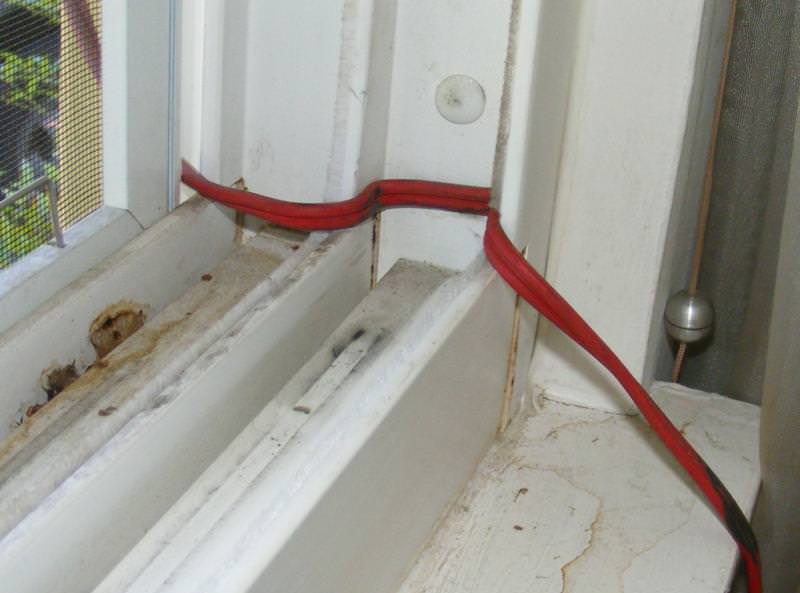
And yet—someone must have thought it was OK.
****
Charles Buell, Seattle Home Inspector
If you enjoyed this post, and would like to get notices of new posts to my blog, please subscribe via email in the little box to the right. I promise NO spamming of your email


Great post. I see this all the time. The biggest extension cord problem I see at Virginia beach inspections is when they are used for high amperage circuits such as motor loads ( air conditioners, freezers ) electric heaters, etc. An extension cord is designed to dissipate a small amount of heat but if it’s warm to touch it should not be used. Even heavy duty extension cords should not be used on certain equipment and appliance loads. It should also be noted that the extension cord itself will add to it’s own electric load because it takes more amperage for the voltage push through that extra wire.
Help please. My husband has 9 power strips connected to a multitude of extension cords in our one car garage. He has most everything on at once when he’s out there working out and/or watching TV(with the exception of a car battery charger, air compressor, buffing wheel and garage door opener, which are used occasionally) for a few hours daily. Its insane everything he has plugged into extension cords. 4 fans, 6 different light fixtures, 4 with old wiring, 2 old railroad lights, again old wiring, a stereo and flat screen TV. He also has power tools, chargers from different phones, etc. left plugged in continually even though they are rarely used. Fuses blow in other parts of the house when it rains, and microwave blows a fuse almost every time it used now. But he sees no problems!!
Please call an electrician as soon as possible.
Extension cords are completely safe for use supplying electricity to outdoor buildings, water features and homes as long as they are run through garden hose prior to burying. The garden hose should be filled with water to allow adequate cooling. At Tincack’s electrical our team often wires outdoor urinals to 120vac or 240vac to kill squirrels and varmin that sometimes try to live in the toilets. For this we use buried extension cord with no issues. So for toilets and lighting no issues, only if you put it in the rhubarb would I consult a qualified electrician.
This has to be one of the funniest comments I have ever received—how could I not approve it! 🙂
Don’t forget that using an extension cord to power your garage door opener will void the warranty. The manufacturers want a dedicated power source within 6 ft. of the opener. Period.