Infrared cameras are a great tool for the home inspector, but like any tool, they can be misused or misinterpreted.
These pictures show frost on a roof with a roof surface temperature of about 12 degrees Fahrenheit. I say about, because 12 degrees is pushing the lower limits of what this particular thermal camera can see (FLIR C2, 14 degrees Fahrenheit).


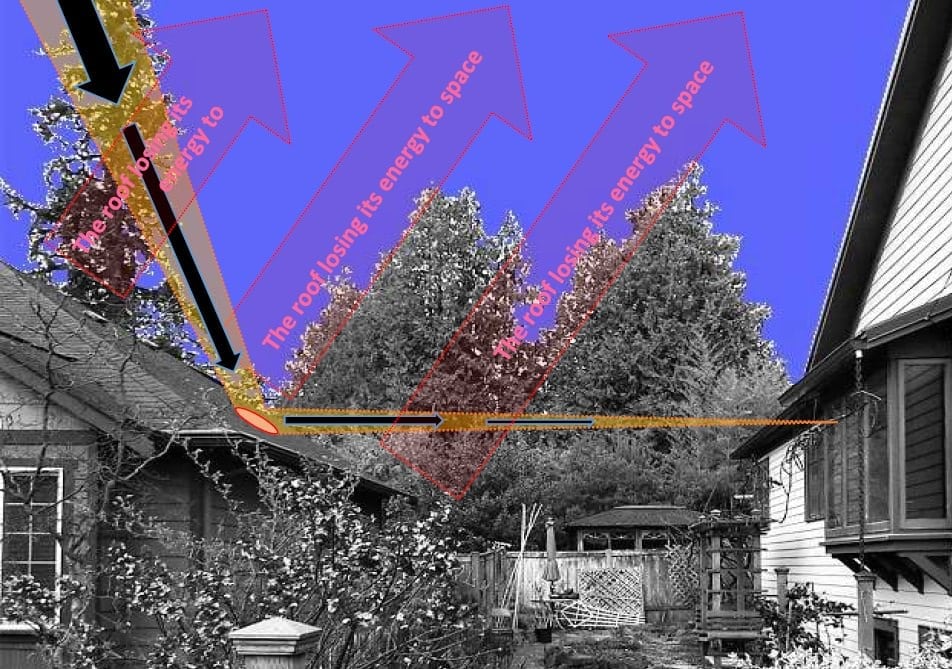
When measuring the temperature of a roof at night, one must be careful to compensate for the much colder temperature of the night sky that the camera can also see by angles of reflection. On a cloudy night this might not be so important–and might not even matter at all. On a clear night the warm roof will give up the heat it has accumulated during the day, to the cold of space. As it does so, the temperature of the roof surface can depress significantly below air temperature.
But, is the actual roof temperature even close to what the IR camera is telling us?
On a clear night, likely not. For a more accurate temperature we would have to shield the roof from the night sky in such a way that the night sky is not influencing the camera’s sensor. In the case of the pictures above, the actual roof temperature was closer to 25 degrees Fahrenheit—still well below freezing. This next picture shows, in a simplistic way, how the camera can see more than the small circle on the roof we think we might be measuring.

With air temperature above 40 degrees Fahrenheit, the temperature of the roof surface can drop below freezing and result in frost on the roof—even though air temperature is well above freezing. Of course there has to be sufficient humidity such that the dew point can allow the condensation to happen and for frost to develop.
This condition is very common in the NW in the Spring and Fall. See this link for more information about this phenomenon called night sky radiational cooling.
By Charles Buell, Real Estate Inspections in Seattle
If you enjoyed this post, and would like to get notices of new posts to my blog, please subscribe via email in the little box to the right. I promise NO spamming of your email! 🙂

 There is arguably no bigger difference between housing on the East Coast and housing on the West Coast than notions of “symmetry.” On the East coast (and please don’t start throwing the exceptions at me–I know they exist—plenty of them—I am just doing a little tongue-in-cheek generalizing) housing is more symmetrical—god help you if you design your house with a front door that is not in the absolute center or that the windows on either side don’t match or the dormers don’t match. You could be placed in the stocks, publicly flogged, or burned at the stake, for such oversights.


 Is there actually a conspiracy or just a huge misunderstanding? Listening to agents we get one perspective, listening to inspectors we get another, and listening to clients we get yet another. It seems all parties to the transaction act as if there is some established “standard” that home inspectors should be following, and if they would only do that everything would flow smoothly to closing and everyone would be happy.
