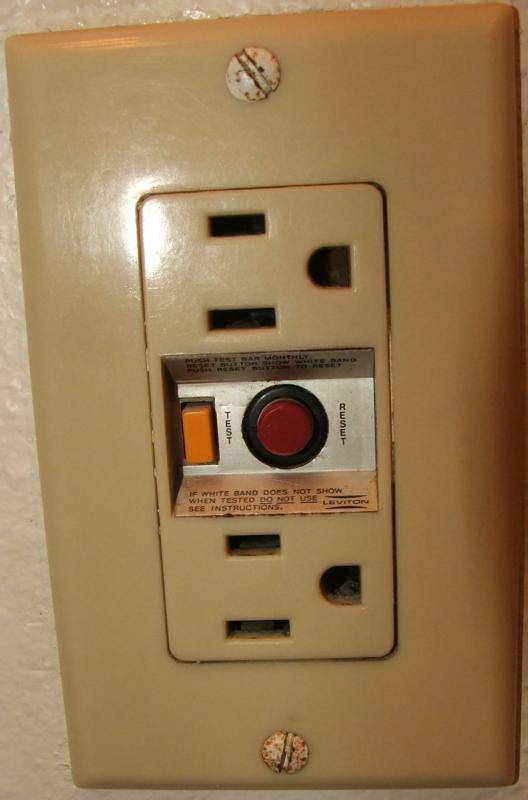
Current requirements call for their being GFCI protection of ALL 120 volt receptacles in your home’s garage. There used to be exceptions for dedicated refrigerator circuits and garage door openers but now these exceptions are no longer allowed in most jurisdictions.

Some people argue that putting refrigerators and freezers on GFCI protected receptacles could result in the refrigerator or freezer not having any power and this might go un-noticed resulting in the thawing of foods.
I think in time refrigerators and freezers will all have lights and alarms to let you know when power has been lost—-some do already. There are also some handy little devices like the THP 207, POWER FAILURE ALARM & SAFETY LIGHT, that can be purchased to do the same thing.
These devices plug into the receptacle that the refrigerator or freezer is plugged into. They are also great to use in conjunction with sump pumps. When power is lost, an alarm sounds and emergency lighting comes on. They are designed to hold a charge for up to 8 hours—-enough time for the homeowner to wonder what the heck that noise out in the garage is—-and go turn the tripped GFCI back on.
Inspectors will love these things too when they inadvertently trip a GFCI and they can’t find the location of the GFCI—as long as it is plugged into the same receptacle that has the GFCI device 🙂 .
By Charles Buell, Real Estate Inspections in Seattle
If you enjoyed this post, and would like to get notices of new posts to my blog, please subscribe via email in the little box to the right. I promise NO spamming of your email



 The year 2012 marked the beginning of the demise of the standard 100 watt to 40 watt incandescent light bulb—the long lived legacy of Thomas Edison (and many others). Initially there will be some “exclusions” for reflector type bulbs and other specialty bulbs, but in general—-the intent of the law is that incandescent bulbs between 100 watts and 40 watts will be replaced with Compact Fluorescent bulbs (CFL’s), and Light-Emitting Diode bulbs (LED’s).
 Incandescent bulbs have a very important feature beside the “quality of light” that they emit. They produce a LOT of heat. In some respects this can be a good thing—-like if you are trying to heat your house in Minnesota. But, they also produce this same heat when you are trying to keep your house cool in the summer—-a bigger problem in regions that stay warm all the time.
 Some would argue that it is “false science” to pick on light bulbs that are such a small part of overall energy use. They argue that legislation would be better suited to putting limits on carbon emissions (reducing coal burning power plants) and banning SUV’s (watch out soccer moms). I would argue that all of these things (and many others) can handle a little scrutiny.
