By Charles Buell, Real Estate Inspections in Seattle
If you enjoyed this post, and would like to get notices of new posts to my blog, please subscribe via email in the little box to the right. I promise NO spamming of your email
Consulting on Building Science and Forensics in the Seattle Area (Formerly Charles Buell Inspections INC)

By Charles Buell, Real Estate Inspections in Seattle
If you enjoyed this post, and would like to get notices of new posts to my blog, please subscribe via email in the little box to the right. I promise NO spamming of your email

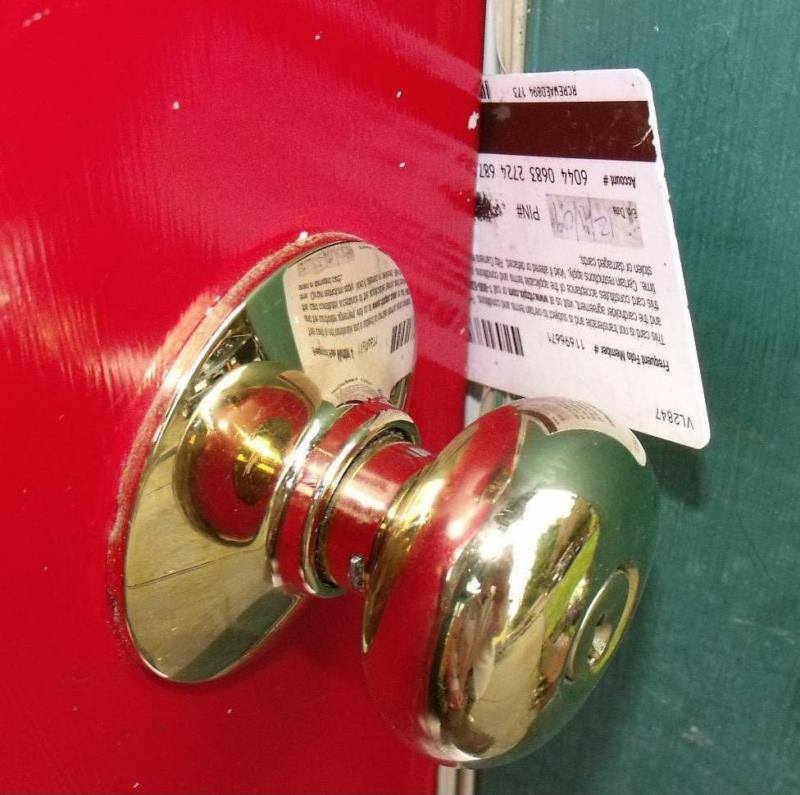
Would you want a credit card that worked even after you have maxed out your credit limit?
Even after the card has expired”?
Let me tell you about the all new all new “forever card.” Just like Forever Stamps—-once you get this card it works “forever” whether you go bankrupt or get divorced—-even if the bank itself goes belly up.
And while it may not be worth a damn if you want to buy something—it will get you in the house when you loose your key—-or your “X” locks you out.
IF—–(There is always an “if” isn’t there?)
If, your lockset is not installed properly, the credit card can get you in the door in a jiffy.
IF—–(Yup—-there is yet another “if.”)
If, the door does not have a dead-bolt, or the dead-bolt has not been locked, the credit card can get you in the door in a jiffy.
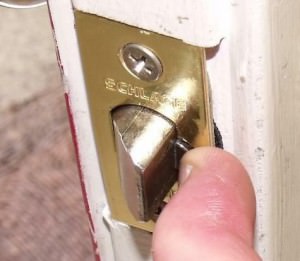
The picture below is what a normal latch bolt looks like that has a “security pin.” The security pin is that little half cylinder shaped thingy on the latch bolt.

In this next picture you can see the security pin depressed into the edge of the door.

Under normal operation, the latch bolt enters the hole in the jamb but the pin stays recessed in the edge of the door. You see, if the security pin stays in the edge of the door the latch bolt should not be able to be pushed into the edge of the door when the door is locked. In the unlocked position both latch bolt and security pin easily push into the edge of the door.
In the “locked” position this pin should stay “inside” the edge of the door. If it enters the strike plate on the door jamb—-the door can often be credit-carded to open the door.
Essentially what this means is that the door is NOT ACTULLY LOCKED—if the security pin enters the strike plate.
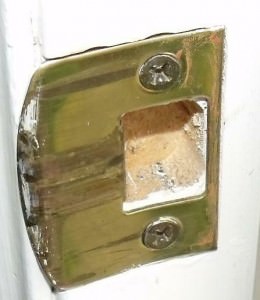
The picture to the right is of a normal strike plate. The security pin should not enter the rectangular opening made for the latch bolt.
The above scenario is for “in-swinging” doors.
The same condition on an “out-swinging” door (without a security latch cover) makes entry even easier—-only this time one would use a pocket knife instead of a credit card. The solution is to move the strike plate toward the weather-stripping enough to prevent the pin from entering the hole—-usually 1/8” or less.
Because there can be lots of other variables and because this is a personal safety issue, this repair should only be done by someone that knows what they are doing. Doors that have metal interlocking types of weather-stripping are much less vulnerable to this defect. Doors that have the cushy foam type weather-stripping are the most vulnerable.
I find this condition on nearly 80% of all doors with this type of a lockset—-so go check yours now—-and report back here what you discover. Of course doors with dead-bolts make the door secure—regardless of what is going on with the hand-set.
By Charles Buell, Real Estate Inspections in Seattle
If you enjoyed this post, and would like to get notices of new posts to my blog, please subscribe via email in the little box to the right. I promise NO spamming of your email
I know that you would rather be listening to the Jefferson Airplane than reading this—-but oh well.
Plastic piping in homes is becoming the norm. It is pretty rare to find new construction with anything other than PEX type plastic pipe—-or perhaps CPVC plastic pipe. I don’t have any heartburn over the use of PEX in homes—-in many ways it is a better choice than copper and is certainly cheaper. As far as installation problems go—they have no more issues than metal types of pipes. All systems are only as good as the installer doing the work—and or the occasional factory defect.
Problems can occur though when homes are changed to plastic piping, or have plastic components added to the metal piping systems. Without getting involved in discussing all the rules/requirements of electrical “grounding & bonding,” suffice it to say that all metal piping systems in the home have to be bonded (connected) to the electrical service ground.
People that do not understand these electrical bonding requirements sometimes break the continuity of these bonded metal piping systems by installing plastic components. This frequently happens when metal drains or water supply lines are broken to add drains to new locations or supply water to new locations.
In the following picture we can see where someone has spliced white PVC plastic into the main water line to install a lawn irrigation system. This installation potentially leaves the house side of the plumbing system disconnected electrically from the grounded electrical system—-and possibly even leaving the whole house disconnected from one of the means grounding the whole system.

This repair can be as simple as jumping across the plastic component with a “jumper wire” or as complicated as having to run a new ground wire to the pipe on the street side of the plastic. In this next picture we can see where a “bonding jumper wire” has been installed around a plastic water filter.

Either way, the system will need to be evaluated and repaired by the Licensed Electrical Contractor.
By Charles Buell, Real Estate Inspections in Seattle
If you enjoyed this post, and would like to get notices of new posts to my blog, please subscribe via email in the little box to the right. I promise NO spamming of your email